Trying to get back into a bit of a social media rhythm here — watch this space for news about the Town Generator! Or you can watch Blue Sky, if that’s more comfortable.
Musings about Daggerheart
Ok, so, Daggerheart. I’ve been running it for about a year, and roughly the same way I ran D&D. After the Daggerheart GM workshop at Gen Con 2026, I think I latched onto a way to make Daggerheart work for me. The party was diving into a dungeon that piqued their interest: a lush pyramid greenhouse in the middle of the desert. The pyramid was designed to teach alchemy and house any who wished to live there, and a cataclysm turned its creator into a plant-based snake and rendered all the people into ghosts. In the deepest parts of this pyramid, a pair of mages are fighting over a crystal that holds Thenevar, the Scintillating Doom, a dracolich that was part of the cataclysm. The energy leaking out from this fight is causing disturbances in the undead created by the cataclysm.
So in a traditional prep, I’d have keyed up all the rooms. This is always a struggle because, to create a sense of exploration, I prefer my dungeons to be both big and Jaquaysed. I know my players are likely to see only a third of the rooms, which often creates a sense of wonder in my players about what they might be missing. This is wonderful, but also a great way to waste a lot of prep time. Here’s where Daggerheart really sang for me.
I decided to turn the dungeon into an mini-Environment stat block and room types as a mini-environment stat block. When the party enters a room, I can use the two mini-environments to run the room.
What I learned from the GM Workshop at Gen Con was to consider two things when making an environment: think about the fiction or fantasy I’m trying to create, and choose impulses as what the environment “wants to do” to create that fiction. Then, for each of those impulses, create actions: GM moves that I can use at the table to reflect that impulse.
So, here’s what I wrote down.
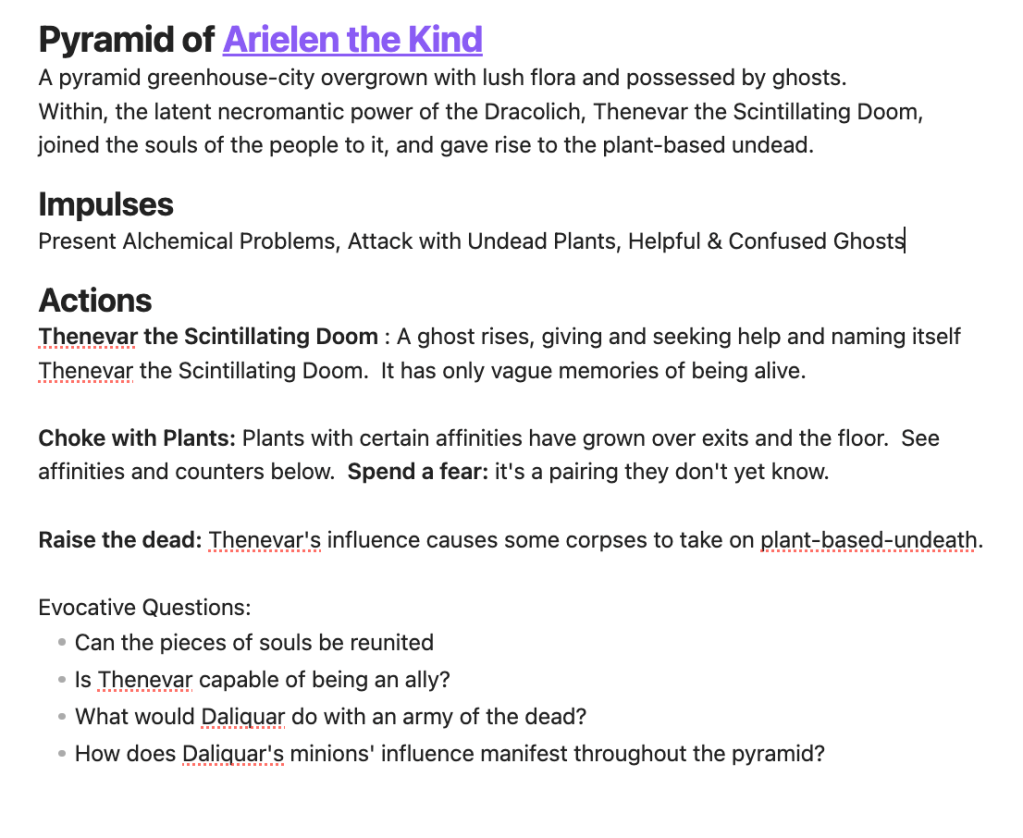
Greenhouse Pyramid, Environment
Impulses: Present Alchemical Problems, Attack with Undead Plants, Helpful & Confused Ghosts
Actions
- Raise a helpful/confused ghost: A ghost rises, it has only vague memories of being alive, and its identity is confused with Thenevar, the Scintillating Doom. All ghosts think they are Thenevar.
- Choke with plants: Plants with certain alchemical affinities grow over an exit of the room, requiring the use of alchemy to clear the way. This move costs a fear if it is an affinity that the PCs do not yet know.
- Raise undead plant zombies: Spend a fear to have zombie-plants with alchemical properties emerge from the walls. Think Last of Us – number of enemies corresponding to the size of the room.
Laboratory (Sub-Environment):
- Scattered equipment, abandoned experiments, shelves of notes
- Impulses: Raise more questions than you answer, hint at deeper mysteries, teach alchemical pairings.
- Actions:
- Unstable Experiment: An experiment goes horribly wrong. Think Toxins, Explosions, Spore clouds. DC 14, 2d6+3 damage.
- Questions: What are the warning signs? What would be too tempting to pass up?
- Should I drink it? A concoction promises power… or poison. Roll a random consumable and interpret it as imbibed.
- Reveal Affinity: Demonstrate an alchemical ingredient and its counter.
- Hint at solutions: Notes on aspects of undeath, and ways to conceal oneself from the undead.
Living Quarters (Sub Environment)
Beds, Desks, Armoires, Shelves
Impulses: Reveal the Past, The Ghosts are People – not monsters, Hidden Treasure
Actions:
- Reveal the past: a scrap of writing or dialogue hints at what was happening leading up to the Cataclysm.
- Angry ghost: Spend a fear when the PCs take a personal item when a ghost is present. This causes nearby ghosts and plants to become aggressive.
Questions: What does the ghost say and do to signal that taking the item will result in a drastic change of tone? - What I was doing when I died: a ghost appears and acts out their routines from before the cataclysm happened.
- Hidden Treasure: Secret panels in furniture, or walls, often revealed by roots that grew through the walls, contain valuables. Choose a treasure parcel from prep list. See Angry Ghost above.
Discussion
It did not take me much time at all to think about the core fiction I wanted to be able to convey in each room. All I needed was if a room was a laboratory, living space, common area, or transitional space (I had environment blocks for those, too).
With these actions, I could reflect on what had happened in the session so far, and choose an impulse to promote. The result was no wasted prep, because I could make each room feel unique even when they used the same environment just by choosing different actions/impulses. My players responded really well; in our post-game discussion they noted an improvement over times when I’ve had keyed rooms.
So, by really honing in on the fiction I was trying to create, and spending a moment to think about moves I could take to create that fiction, my prep was faster, efficient, and our game was at least as smooth as my traditional prep. It’s the first time I really felt like I was playing Daggerheart the way it is meant to be played.
(I also started a countdown timer, counting down on rolling with fear, representing the mages fighting over the gemstone. This created a lot of forward momentum for the party, attempts to find solutions that didn’t require duality rolls (an OSR principle I prefer), and a very dramatic finish!)

