• Contact

Missives from a Mathemagician

  • Backward Design & Session Prep

    June 12th, 2024

    Introduction

    Backward Design is a technique in which we begin our prep with the end in mind (what we want to see, or what our goal is for a certain point in the game). From that goal we identify precursors to it, that is, events/ideas that could directly reach the goal. Then, for each of those events/ideas, identify/create events and ideas that immediately precede them. We repeat this process until the direct links are something that we can do right now. It is “backward” because you are looking at the end of the journey and

    1. identifying a step right before the end; then
    2. identifying a step right before that; and so on, until
    3. you arrive at a step you can take right now.

    In Education circles, Backward Design comes up a lot in assessment and instructional design. Here’s a link that I think does a good job introducing it in that context: MIT Teaching Resource.

    This visual might help. We start at the top and work our way down until we arrive at something that we have at the beginning of our session.
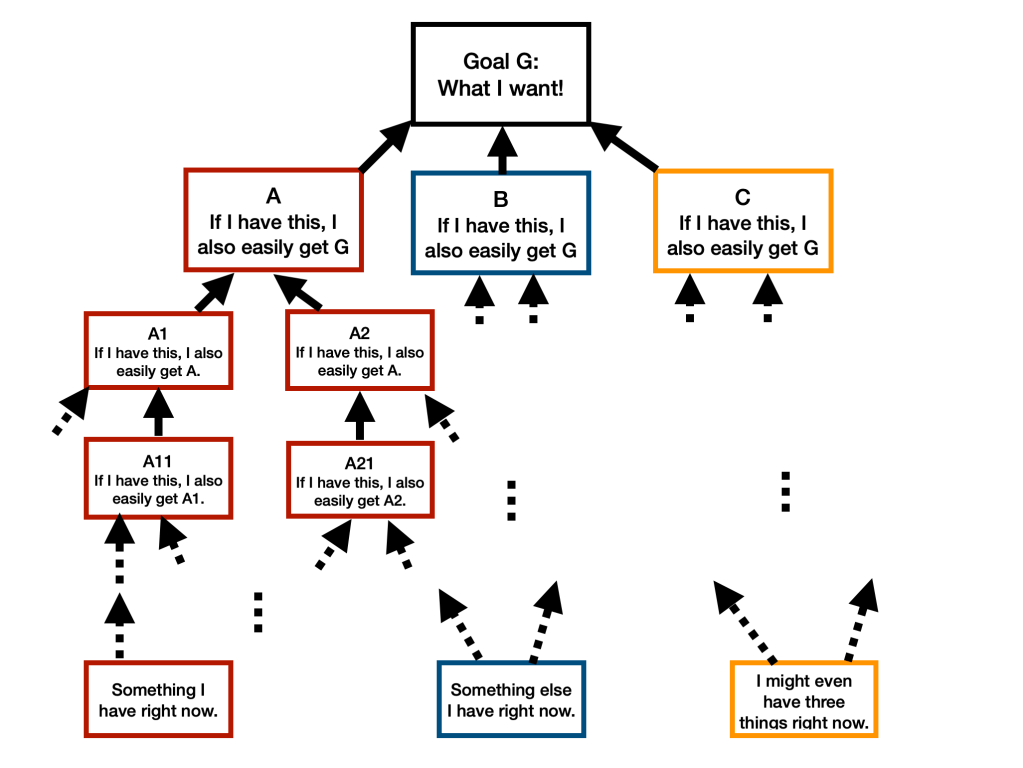
    A flow chart starting with the goal at the top and identifying precursors until the start is reached.

    To illustrate this method, this blog post shows how I incorporate the Three Clue Rule, which I picked up from Justin Alexander’s blog, and Secrets & Clues I picked up from SlyFlourish’s Lazy DM steps. The result is something that The Alexandrian would call a node-based design, in case you are looking for such examples.

    Disclaimer

    The following scenario is for my homebrew campaign. Some canon changes feature below: Iuz is now a devil and rules a city of Impious Pinatus in the Soul Sworn Empire. Each district of Impious Pinatus is named after one of the nine hells. It is an oppresively lawful city.

    Scenario Concept

    The PCs are levels 16, 17, 17, 18 and ?? (owing to a death last session and a wish to not be resurrected). They seek to infiltrate Atria Dolores, a floating castle above the City of Impious Pinatus. We begin when they arrive at Impious Pinatus.

    Starting with some Secrets

    • Secret 1: The Floating Castle is an illusion; mundane access will not work.
    • Secret 2: Atria Dolores is actually in Avernus.

    Backward Design

    Following the idea of the three-clue rule, we seek to dream up three different ways that the PCs to might gain access to Atria Dolores.

    Way 1) As high-profile characters, if they were to be captured they would be held in Atria Dolores instead of the Stygia district.

    Way 2) The highest court of bureaucracy is held in Atria Dolores. There is a portal to the waiting lobby in the Maladomini district: specifically in the Lex Praetorium.

    Way 3) The party can obtain a tuning fork associated with Avernus and use plane shift (or choose Gate at level up). They might get shunted close by, due to wards, but it is a fruitful way forward. Mundane access from there would work.

    At this time, I don’t want more details, so that I don’t waste prep on two of the ways when the party chooses one. Visually, we represent this like this:
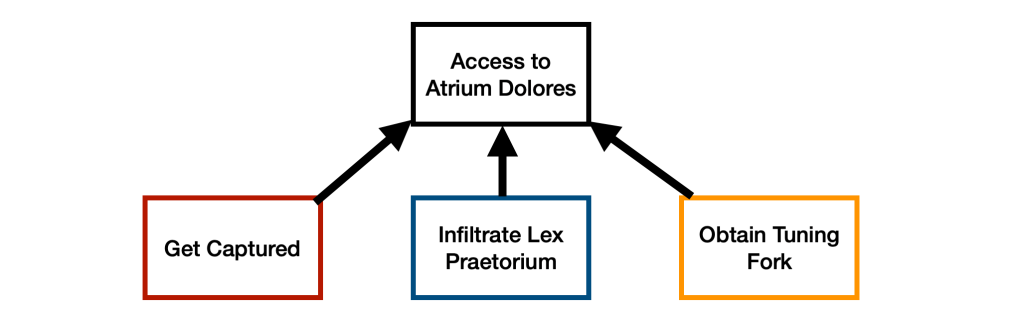
    A diagram showing "Access to Atrium Dolores" at the top, and three boxes connecting to it, labeled "Get Captured" "Infiltrate Lex Praetorium" "Obtain Tuning Fork"

    Now we have our three ways for the party to get in. Now, applying the Rule-of-Three again, we seek to identify three ways the PCs can access each of Way 1), Way 2) and Way 3). Some of the below is already prepped stuff from previous excursions into Impious Pinatus, others I need to invent. So if you see “name later” or something similar, that’s what I mean. I don’t want to name or create anything until I know it will stay in this step, and until I see how it’s all connected.

    Three ideas for Way 1

    For way 1) What are three ways that PCs might get the idea to get themselves captured?
    1.1 ) Rumors: Resistance group (give them a name later) has been looking for, and cannot find, high-profile criminals (also to be named) encased in the ice of the Stygia District. They conjecture that they’re held in Atria Dolores itself.

    1.2) A major trial (against whom? decide later) is going on in the Phlegethos District, being overseen by the Androsphynx, Thoth, and the sentence will mention imprisonment in Atria Dolores.

    1.3) In the Lex Praetorium, political protestors are upset about changes to maximum sentencing. Some prisoners may be imprisoned in Avernus itself instead of in the Stygia District. Some protestors think Atria Delores must be connected to Avernus somehow.

    Three ideas for Way 2

    For Way 2) What are three ways that they might discover the existence of a portal to Atria Dolores in the Lex Praetorium?
    2.1) Political Protestors (from 1.3?) can be led by someone (name later!) demanding an audience directly.

    2.2) Resistance Group (again name later) has been plotting a reconnaissance mission, centered on breaking in through the portal. They haven’t done much planning beyond that (that’s the player’s job!).

    2.3) Overhear a high-profile merchant (perhaps Vae, the Merchant of Pain, or a merchant at the Horologium Diaboli (Artificer’s Guild) discussing having business directly with the upper bureaucracy.

    Three ideas for Way 3

    For Way 3) What are three ways they might discover that they could obtain a tuning fork to Avernus to get to Atrium Dolores?
    3.1) This would be a basic result from research at the Librum Mallum (only a few PCs are actually allowed in there after their last visit, though!)
    3.2) A low level mechanic (name later!) at the Horologium Diaboli is experimenting with them to pull infernal energies in to power their machines. His work can send messages to Atrium Dolores.
    3.3) The Dream Eater G’her is aware of this, and where one might obtain them. It only costs a small price and a dream!

    Updated Picture

    Expanded diagram, showing the three ideas connecting to each of the ways.  "Resistance Group & Rumors about Stygia District", "Trial in Phlegethos District", and "Protestors outside Lex Praetorium" connect to "Get Captured" and so on.

    In fact, now that we’ve laid it out, I can see an easy connection from a Merchant to the Tuning Fork, and from the Librum Mallum to the existence of a portal in the Lex Praetorium. And the resistance group probably knows something about direct access to Avernus, even though that’s far above the Resistance’s spellcasting ability.

    Recap on Backward Design

    To see how Backward Design is applying here, I think of it like this: I want my PCs to be able to access to Atrium Dolores. If they were captured, that would suffice. They could discover that being captured would suffice if they overheard the resistance group talking about a high-profile member who was captured.

    The idea is to keep working backward (e.g., how might the PCs overhear that conversation?). We will keep working backward until we get to a place where we are at our starting point (in this case, arriving in the city or some immediate obvious action we know the PC’s will take upon arrival).

    We don’t necessarily need to use the rule of three here; but with more connections, we can more robustly we can respond to PC actions and investigations. Put another way, if the PCs do something unanticipated, a web of connections is more likely to be able to be adapted in response. Let’s say they take their boat to Impious Pinatus and bond with someone at the docks. Maybe that dockhand’s brother is the resistance person being held in Atria Dolores; now the PCs have additional motivation but also a reason to talk to the resistance.

    Finishing the Backward Design

    So how might they connect to the resistance group? Well, I can put some resistance group members:

    1. on random encounter tables for each district.
    2. in taverns and inns — they might chat up the PCs especially if they recognize them from the last time they were in town.
    3. as a planned resistance-vs.-law encounter to inject if the session needs some action.

    Likewise, visiting a tavern or doing any kind of seeking for more information would point the PCs to the Dream Eater, G’her, as a sort of information broker. This is the kind of thing that I think Sly Flourish would classically call a secret. The existence of G’her is a bit of direction one can bring out in response to many PC actions.

    Any merchants that they visit can be gossiping about Vae having special access, or the up-and-coming merchant/tinkerer named Clockwork (the name just came to me!), in the Horologium Diaboli.

    I will also quickly prep wanted posters regarding a past PC-turned-antagonist, Maia, who has been raiding merchant routes in connection with the resistance group, and advertisements for the Dream Eater’s information brokerage, Sleep It Off. I’ll hand out these fliers as part of a random encounter.

    Updated Picture…again!
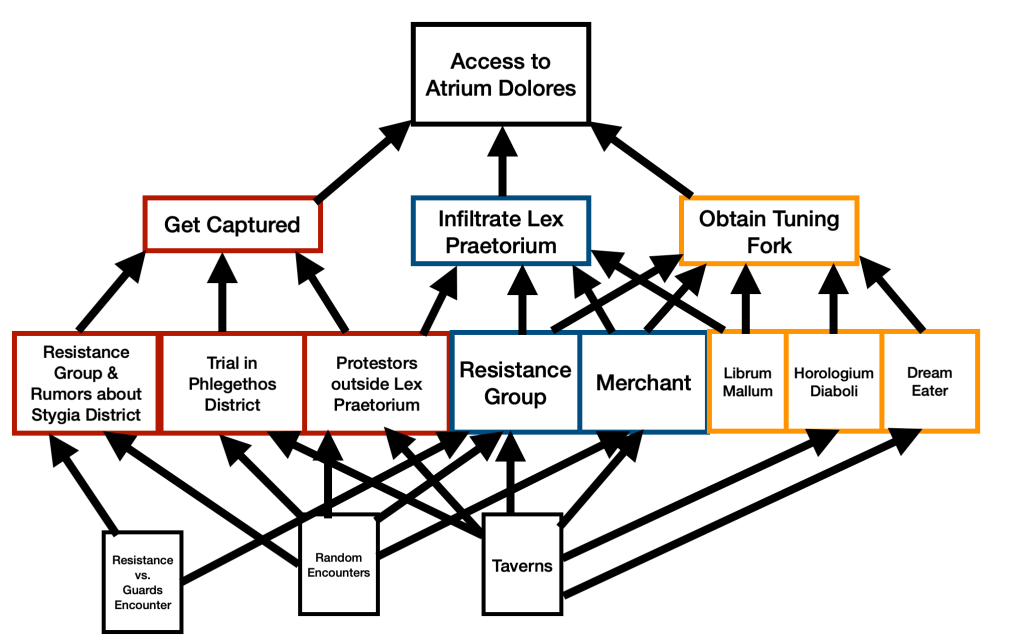
    Now "Resistance vs. Guards encounter","random encounters", and "taverns" connect up to the row above in various ways.  All of the boxes except Librum Mallum have a connection to the start.

    The only thing that isn’t connected to something the PCs are likely to do naturally (e.g. go to a tavern / inn, or wander into a random encounter), is the Librum Mallum. This was a major adventure site the last time the PCs were in the city, so all I need to do is remind them that more information can be found there when I’m re-introducing the city and recapping some of their adventures therein.

    This gives an outline of what is needed. I’m ready to dive in and prep these connections (which we can think of as nodes from The Alexandrian’s blog).

    Prep…. what am I to do with this many things?!

    I think it’s also unreasonable to prep all this in a lot of detail. In fact, the diagram structure shows that a lot of that prep could be wasted. After all, if the party goes to a tavern and realizes that they can obtain a Tuning Fork at the Horologium Diaboli, it will have been a shame if we spent a lot of time prepping details around the party getting captured and their eventual jailbreak.

    However, we must be ready to do the jailbreak thing if they get that far!

    Depending on how long the sessions are, and to what extent a group engages in roleplaying, we might not make it all the way to Atria Dolores by the end of the session. That means when we stop, we will know more about what path they might take, so we can prep that in more detail. So what I like to do is have the tools that:

    1. Don’t take me a long time to make
    2. Will let me spin up the needed scenario if it comes up.
    3. Can be reused if possible.

    As I write all this down, I realize I’m most anxious about the Prison Break scenario. So I’ll start there:

    I need a way to generate a holding cell. My notes will say “3 rooms, dice drop and geomorph connection”. For you, dear reader, that means I’d generate three rooms by dropping d4s on a piece of paper. Where the dice land is a junction of walls, and the number of walls at that junction is determined by the number showing on the die. I’ll draw a room based on that, making some logical connections and add in the prison cells and a guard station. I’ll use geomorph tiles (I use these: https://store.inkwellideas.com/collections/dungeonmorphs) to connect the holding cells. As they explore those geomorphs, I’ll need to be able to quickly spin up some rooms, and some encounters. Since the PCs may be few in number and without their equipment, I used Forge of Foes’ combinations for a hard encounter for lvl 10 PCs just to get numbers of some of these monsters.

    Room : 1) Quarters, 2,3) Legal Studies, 4) Torture, 5) Meeting room, 6) Storage (pre-roll some random treasure to have amid sundries)

    Encounter: 1) 1–4 Merregons, 2) 1–4 Devils appropriate to the room (use Bearded devil up to Magistrates [from MCDM Flee Mortals] 3–6). Currently empty.

    That’s enough to get me started with the prison break. With them split into different cells, the moment they rejoin and find their gear, would be an excellent end to the session and I can end on a cliffhanger (the door swings open to reveal!) and then prep a detailed map for the next session, since I know now where to focus the prep.

    In fact, I can use this same random die drop / geomorph method for the Lex Praetorium. Fighting their way through the enemy force in the material plane feels like level 10 is about right – I want them to feel strong for forcing their way through; the real challenges will be in Atria Dolores, closer to the vault! If they get caught either sneaking or fail to bluff their way through that scenario (more on that later), I’ll use a Forge-of-Foes inspired hard fight: a group of Gilded Devil (from ToB 1) + 3 Merregons will be good enough for now! Just gotta get things on paper for this stage of prep.

    If they happen to obtain a tuning fork and planeshift their way in, I’ll be prepared to use geomorphs and random generation to get a map in front of me. With some more prep time I’ll prep that map in more detail, but for now I need something good enough.

    The encounters closer to the treasury they seek should be hard for them, again using Forge of Foes to get some numbers:
    Mixes of Legates (MCDM) and Chain Devils up to 8 for one group, and another group of magistrate + 2 bone devils + 2 legates; sounds like a good deal to me to be ready for combat. Moving on!

    Ok, that makes me feel prepped no matter how they arrive in Atria Dolores, I’m ready to describe some things and keep it moving until the end of the session.

    I’ve got a map generation method to describe Lex Praetorium if I need to.

    So what remains is to detail the bits that could come up in the city. Just a few sentences will do:

    1. The Dream Eater, G’her:
      • Think seedy opium den. The way this works is that the Dream Eater will give you the knowledge you seek, in the form of a dream, at the cost of one of your hopes, dreams, or aspirations.
      • They can trade secrets about Iuz that they know instead of the hopes/dreams/aspirations. A particularly dangerous secret will make G’her panic.
    2. Resistance. It’s a group of Tieflings, calling themselves The Finis Ordinis (in my homebrew, almost all denizens in Iuz’s Soul Sworn Empire are Tieflings)
      • Freedom: Tiefling dude, easy going
      • Chaos (the leader): Tiefling woman: think the Joker — is she serious?
      • Fierce: Tiefling non-binary, very intense.
      • Flock: Tiefling male, spiteful and angry — he’s the one on Trial for spreading information about Iuz.

    That’s probably enough to go off of. We’ll just seed them into random tables in and around the city.

    Leaning on some prep I’ve already done for the city, I can easily add these resistance members to random encounters in the districts, and have them show up at Taverns, and instigating in protests.

    For example, here are my existing brief notes on the Phlegethos District:

    “Justice” & Pleasure Palaces.

    Half of this area is dedicated to holding Soulsworn & Freefolk accountable for crimes.  Cages, stocks.  The other half, often across the street, is pleasure palaces.  Gambling.  

    Notable Landmarks:
    The Laughing Stock — a tavern and jailing complex.
    Wild Den — Exotic Dancers & Gambling
    Sleep It Off — G’her, the Dream Eater, runs this establishment.

    Random Encounters (roll 2 d10s, combine results)

    1. A birdfolk, Bjorn, hanging in a crow’s cage
    2. Children playing Anima Capens
    3. The Androsphynx, giving a sentence
    4. A drunk centaur, stumbling, Anahera
    5. An emotionless Satyr, Deimos, his soul sapped by G’her, the Dream Eater
    6. G’her, the Dream Eater
    7. Advertising for the Wild Den
    8. Beggers pleading for food or coin
    9. A Tiefling, Night, locked in stocks
    10. Merrogons taking someone in for justice.
    

    Instead of my usual roll 2d10 and combine, I’ll add a resistance member and combine with the d10 roll.

    Connecting back to the Lazy DM secrets and clues, the fact that there’s a trial to be heard in Phlegethos District, that the Dream Eater has information for sale, that the Horologium Diaboli has a new inventor on track for some breakthroughs, etc, all become secrets.

    Rules of thumb for social situations in this scenario

    The last thing I need to do is make a note to myself about the social situation. Fruitful ways forward in any social situation will be:

    1) Appeal to Law. There are so many loopholes in the law, that it is always plausible that one applies, or some ancient law also applies. Generally, DC 20 check and a plausible loophole will get the PCs out of trouble.

    2) Exploit Chaos. Strategic and convincing revealing of truths of Iuz’s chaotic nature can undermine authority.

    3) Exploit treachery and ambition. As an organization of devils, they can be easily tempted to betray their superiors if they think they’ll supplant them. High level adventurers are just the type to disrupt the order!

    4) Appeal to evil. Unlikely to come up on the players instigation, but selling one’s soul can make a lot of problems go away!

    In Conclusion, at last

    We started with the end in mind: we want to get the party to infiltrate Atria Dolores. We identified three ways they might do that. Then for each of those ways, we identified three possibilities through which that way might be realized. For each of those possibilities, we worked our way back until we had items directly connected to the starting point of the scenario.

    Recognizing that we probably don’t have time to prep everything, we prepped tools that would allow us to spin up the scene if the PCs go that way. The thing I know for certain that I will need next is Atria Dolores, so I can begin to prep that in case the party goes super fast!

    By visualizing the connections, we spotted new connections. I didn’t draw them on the image, but perhaps you can see horizontal connections too — this can lead the PCs from, say, G’her to the Lex Praetorium, which might come up in conversation.

    With the arrayed scenes and tools, I feel like I can respond well to PC inquiry and actions related to their goal of infiltrating Atria Dolores. If they don’t have their own plan, I have ways to use what actions they do take to illuminate the possibilities of plans for which I am ready. If they come up with an unanticipated plan, I can use the random tools to respond to it or find a way to connect it to the prep that I’ve done.

    One word of warning

    This technique could theoretically be used to map out an entire campaign. However, if one’s goal is too far away from one’s starting point, then I think there is a great risk in wasting a lot of energy on aspects that simply will not be used because of an early PC action. I don’t mind losing a few branches of this prep because I didn’t prep a lot of details and the ideas weren’t so hard to come up with.

    This technique is therefore better for session, or small arc planning, in my opinion. I use it repeatedly in the campaign. For instance, I’ll use a similar technique for when the party is in Atrium Dolores and seeking the treasure vault, and again for the next adventure. When I know more about how they completed this one, it is easier to connect those actions to the next Backward Design map (in the same way that I know handing out a wanted poster for Maia has a great chance of connecting the current PCs to the resistance group).

    That all said, if you have a notion of what you want a major campaign event to be, then this kind of backward design can get you back to some things to seed into earlier adventures. Just hold it all loosely!

  • Distance and the News

    January 23rd, 2024

    I expect the City States of the Divine Dragons to be points of light in an otherwise dangerous world. Thinking along the lines of designing the world for adventure and to make the characters stand out in their eventual ability to move about freely. To that end, each city state should be surrounded by concentric regions that would present challenges suitable for parties of increasing level.

    To that end, the regions should have random encounter tables of “hard” challenges for levels 2, 4, 6, 8, 10.

    That means, travelling from one City State to the next means risking encounters for levels 2, 4, 6, 8, 10, 8, 6, 4, 2. This will let the players feel quite capable (including having mechanisms to say “yeah, you obliterate the lvl 2 wolf encounter, we’re not gonna worry about that one”), and also feel like “nobody else could do this” when they get to the lvl 10 encounters. Once they can handle lvl 10 encounters with relative ease, adventures should probably take them beyond the material plane anyway. 

    But what about everyone else?

    5e’s bounded accuracy is a boon in this kind of space, because it means that there is a reasonable safety in numbers. Large caravans can move through the regions and drive off even the most aggressive monstrosity that might try to challenge them. River passage might be particularly safe, but, expensive. 

    So what does it take to send a message from one city state to another? (That’s what inspired this post, anyway!)

    If there are people capable of casting spells who live in a town, with very rare exceptions, they cannot cast spells outside of their place of power, and their spells are capped at 4th level, generally — and those are expensive indeed. A 3rd level spell like Sending is a major working of magic and prohibitively expensive for common folk. I am now realizing that I really need to sit down and map out what it takes for non-adventurers to cast magic. 

    So that leaves mainly Caravans and River Traders.

    To me, this all means that the river & coastal towns will be quite caught up with news, since they can get updates with every passing boat, but the further inland a town is, the more lagged the news will be… but the more exciting a caravan will be!

    And, every once in a while, there is the Centaurs on the Path of Seasons, a winding migratory path that winds its way around the continent, completing its circuit every year. One might get some news that way too. 

  • Engaging with the Ritual

    January 22nd, 2024

    My players just wrapped up a major arc and we had an interesting finale combat. I got to use some DIY 3d terrain I made out mostly out of styrofoam packing from my 3d printer, pin-stripe tape, posterboard and printed square grid paper from https://incompetech.com/graphpaper/. Here’s a view from the player side. But what I want to talk about is the yarn and the crystals.

    The Pit Fiend at the top (who was successfully banished by a Dispel Good & Evil spell, more on that another day), was conducting a ritual that was amplified by the arrival of mortal souls (aka, the PCs). In channeling and trying to corrupt the energies of the cosmos, streams of energy flowed toward the Pit Fiend’s ritual site at the top. 

    I marked the orange stream as the top of the initiative, and the blue stream has half-way through the initiative order. When it was a stream’s turn, I applied its effect and then I rolled a d8 to choose what kind of effect it would have the next time its turn came around:

    1. Necrotic (Con)
    2. Chaos (Cha)
    3. Evil (Cha)
    4. Life (N/A)
    5. Law (Cha)
    6. Neutrality (Cha)
    7. Betrayal (Wis)
    8. Good (Cha)

    I would also roll a d12 to determine a clockface to which to orient the stream (i.e. if I roll a 2, it is pointed at 2:00). I think I learned to use d12 as a random direction from Seth Skorkowski’s video on critical hit/fumble tables. I assumed a certain symmetry. I oriented the battlefield so that 12:00 was directly away from my DM screen, so if I rolled a 6:00 I also considered that to be 12:00. Though I didn’t need to do this, the intent was to keep the streams relevant. 

    At the start of the blue/orange Stream’s Turn, any creature between two orange / two blue pieces of yarn (the edge of the corresponding streams) has a different effect based on their alignment. If their alignment matches the stream (i.e. they are a devil and they are in a law or evil stream) then they are healed 2d10 HP. If they do not have the same alignment as the stream, they take 4d10 damage, or make the indicated save for half damage. The life stream healed all mortal creatures in the stream 4d10 HP. I used 4d10 from the trap table in the 5e DMG, which I use a lot for improvising damage.

    The Pit Fiend, or any PC within 20 feet of a crystal, could use their bonus action to change the stream. In so doing, they could change the stream’s clockface up or down by 1 (i.e. 1:00 to 2:00, or 1:00 to 12:00), OR, change the effect up or down by 1 (i.e. shift the Evil stream to the Life stream).

    It created some interesting movement and strategy for the players, trying to position themselves in life streams, only to have the Pit Fiend change it to an evil stream, and then having another player use their movement to change it back. You might have noticed some Demons that joined the fight too — at one point the PCs intentionally shifted a Chaos stream onto the Demons to prop up their HP so they could continue to soak damage! 

    Some lessons learned:

    • It was a good mystery for the PCs that I named the stream but they didn’t know exactly what would happen out of the gate. They were nervous about standing in the life stream the first time, but decided to risk it!
    • Letting them change the stream was really engaging. There was a lot of discussion about that and a feeling like they were interacting with the Pit Fiend because he was also changing them. It is important that they have some time to get out of the way… like a telegraphed attack in a video game.
    • It didn’t quite create as much movement as I anticipated.
    • We definitely got sloppy in orienting to 1:00 or 2:00 by the end. It would have helped to clearly mark out the places the strings would go at the edge of the map, so that it could just be moved and placed there. 

    Accordingly, the next time I do something like this, I think I might not require a bonus action to change the thing, but you might have to be adjacent to something to make the change.

  • Lore24 240122

    January 22nd, 2024

    On the east side of the centerspine mountains, the former country of Dessa has been laid to waste by the undead. A lich calling herself Wynne the River of Death is at the center. Wynne is a Warlock of the River King who went missing in our current game, became undead and rose up through the ranks of the Ghul in the Underworld. 

    Cogadh, the Divine Dragon of War, holds her City-State of Propygrio, as the last bastion of safety against the undead. Unfortunately, the City State of Grafarvad, demense of Eilifur, is on the other side of the continent, and missionaries have not been able to reach Eilifur. Surely if Eilifur knew of the situation in Propygrio, he would ally with Cogadh and together they could turn the tide against Wynne. 

    As a campaign hook, starting in Propygrio would allow for some low-level fighting of undead, a journey across the continent, and then some high-level fighting against undead.

  • Lore24 240121

    January 21st, 2024

    With Veour, the Divine of Weather reborn into the world, weather has gotten more extreme except in his domain. In particular, in areas of the world less under the influence of law, magical weather is more common. Similarly, under the influence of Hreyfendi’s moons, the seasons are amplified too.

    Under the green moon of spring, during magical weather, grasses overgrow and vines can spring to life, slowing travel and making things generally treacherous. Under the red moon of summer, ball fire forms in the wild places, and forest fires can spring up. Druids are especially diligent to control them. Under the yellow moon, the winds almost come alive, and blow particularly hard for days at a time. The fallen leaves form disorienting whirlwinds and some thing that the fell winds bring animus to scarecrows and unburied bodies. Under the blue winter moon, ice forms under feet and children must knock down their snowmen lest they be given animus by the fell wind of chaos.

  • Lore24 240120

    January 21st, 2024

    Let’s zoom in on Arbakka a bit, it’s looking a bit promising for a home base.
    Three things that makes it fun for the PCs to have a base in Arbakka:
    1) An open spot on the town council is available, and supporters for each of the major influences (esp. Hava’s Orchard, Sveidi, and Murad) are vying for it. An influential PC could determine the spot, or claim it for themself.
    2) The town was founded around supporting a wizard’s tower where he experimented on various aspects of exploring the lake and river. He has long since passed, but many of his experiments live on. The tower is easily seen from all parts of town. The enchanted waters make it particularly easy to catch fish, giving rise to a thriving fishing trade. The druids? Not so fond of this.
    3) Kuo-Toa in the river worshipped the wizard as a god, and they believe he will come back to them one day. He convinced them to defend the town from nearby goblinoids. It makes the town uneasy, and they don’t always treat them well.

  • Lore24 240118

    January 19th, 2024

    Musing on some Good vs. Good tensions.

    In our current campaign we are exploring the Tyranny of Law and wonton exploitation of Chaos. So in the next campaign, I’d like to see the Dragons of Law compete with one another for worshippers.

    Aetoch and Siobhal, divines of agriculture and civilization will be the most expansionist, most likely. Their law will push back the chaos, making their lands safer, but at the cost of conquest/expansion. They’ll do this in a non-warlike way, especially since Cogadh is the divine of war. The question is, will they work together, or will they be jealous of one another? I think jealousy is more interesting here.

    If we put the Aetoch’s home, the City State of Sveidi, and Siobhal’s home, the City State of Murad, on opposite sides of some lands caught in between, then they can both seek to expand into these lands. Let’s situate the town of Arbakka along a river in connecting Murad and Sveidi.

    Arbakka is struggling as it lacks the resources to defend itself, and its laws do not push back the chaos that draws monsters to the lands.

    Aetoch promises endless bounties in Arbakka’s fields, and harvest of its river fishing. In growing its agriculture, it will push back the chaos. But only if Arbakka swears itself wholly to Aeitoch.

    Siobhal promises to build walls and incorporate a set of laws and class structure that, although it doesn’t have a lot of mobility and personal freedoms, promises protection and to take care of the health and comfort of all of its citizens… but only if they swear themselves wholly to Siobhal.

    Writing this out — I need to introduce a chaotic good divine of some sort. Someone that doesn’t push back the chaos with law, but protects its people with adventurers.

    Putting Arbakka (are my players going to call this Chewbacca? Probably…) in between these three and putting my players in position to help the town decide would be interesting? Or reductive! But the fallout will be interesting too.

  • Lore 24 240119

    January 19th, 2024

    South of Arbakka in a forest known as Windhome, is a settlement known as Hava’s Orchard. It is overseen by Hava, a Wind Djinn, and brother to Xed and the River King of Dion Deidre. It is said that the Wind in Hava’s Orchard tells Hava of all that transpires in the wood, and he tolerates no action that restricts another’s freedom, harms another, or does not integrate with nature. Failure to live by Hava’s code results in being expelled from the Orchard, though some are offered a quest that, upon completion, allows them to reintegrate with the Orchard.

    The winds of Windhome whisper of incoming danger and guide the people of the Orchard home before danger befalls them. Druids of the Orchard train adventurers who then find ways to drive back the danger of the forest, ideally without unnecessarily killing any natural beast or sentient creature.

    Windhome faces a significant problem: Yuan-Ti have established themselves in the forest, and have opened a passageway to the Lightless Tunnel and, from it, abominations are beginning to take invade the forest.

  • Experimental System for Travel & Random Encounters

    January 19th, 2024

    Hey — what’s below is still in testing, but, I wanted to share it with you!

    Design goals:

    • Players make high level decisions two times each day: Travel, or Explore. For long journeys, the assumption is travel twice per day.
    • Players intuitively understand what the possible outcomes of their choices are.
    • No “nested” rolls — Players leading the navigation do not have to wait for other players to succeed/fail to determine if they have advantage, etc.
    • Quick random encounter determination that includes multiple encounters per day and mixes of encounters and monsters. 

    Overview

    There are three turns each game day. The first two turns are active: the party can choose either a Travel Turn or an Explore Turn. The third turn is a rest turn. Roll on the random encounter table once the parameters of the turn are declared. But first, a few words on the random encounter table!

    This random encounter system uses a dXY table. I first learned about these as d66 tables (I think from Web DM?) , but the idea is you roll two dice, and the first determines the row to reference, and the second determines the column. Read the dice in the order they lay in the rolling area.

    Roughly, I have it set up so that higher-numbered rows correspond to more monster encounters, and higher-numbered columns correspond to more location encounters.

    Here’s a first draft of a table, I haven’t fine tuned encounter probabilities… this just feels like its in the ballpark for now. Horned faces are monster encounters. Warning signs indicate that is more likely to be tracks, or some monster sign instead of an encounter. Red Torii gates indicate that a hidden location is found. If multiple symbols are appearing, it is DM discretion as to how to combine them for the day. That is, a monster might be encountered at the location, or on the way to it, or ambush them after they’ve spent some time there.

    If the party chooses a Travel turn, they must do 2 things:

    • Declare a navigator that will make a wisdom/intelligence (survival) check based on a DC for the circumstances (environment, weather, etc)
    • Declare travel modes. Choices include:
      • 1/2 Speed & Stealthy
      • 1/2 Speed and look for hidden locations along the way
      • Normal Speed
      • 3/2 Speed & Higher Monster Encounter odds.

    Distance Travelled in one turn is: 4 x Speed /10 x Speed Factor x Environment Factor, in miles, or it is easier to just assume the default is 12 miles, or one hex, and modify up or down by halves, accordingly. Pull liberally from the Alexandrian Blog, linked below, for environment factors.

    Travel Mode

    In Travel mode, the default is the d64 section of the encounter table: so d6 for the row, d4 for the column. This is modified based on the choices above:

    • If the party chooses the 1/2 speed and stealthy, the row die becomes a d4.
    • If they choose 1/2 speed & look for hidden locations, the column die becomes a d6.
    • If they choose 3/2 speed, then the row-die becomes a d8.

    They can go to 1/4 speed to be stealthy and look for hidden locations, if they are so inclined.

    A particularly dangerous area might start with the row-die being a d8 instead of d6, so then the die-size steps up and down accordingly.

    In travel mode, the party can also optionally perform other activities like foraging, at a +10 DC penalty.

    Navigation Check (Int (Survival) or Wis (Survival))

    • DC is set by the environment & weather
    • Failing the check by 5 or more: the party veers (per Alexandrian rules, link below) and has an insecure campsite (increase row-die one step during rest).
    • Fail the check, but not by 5, the party veers, but the campsite is standard.
    • Succeed: navigate in the desired direction, standard campsite.
    • Succeed by 5 or more: navigate in the desired direction, secure campsite (decrease row-die by one step during rest).

    For navigation checks, I’ll use my “roll with uncertainty” mechanic: The player tells me their stat+skill bonus, and I subtract that from the DC and make a note. The player then rolls four d20s and reads them in whatever order they like. Behind the screen, I roll 1d4 and use that to select which d20 to care about, and see if it is above the number I noted by subtracting the bonus from the DC (this is mathematically equivalent to adding their bonus to the die and comparing to the original DC, just faster for me).

    For longer journeys, where we know the travel action will be taken twice (unless a desire to consistently seek secure shelter is expressed), I’ll still use the uncertainty roll, but I’ll use two d4s to choose two different dice, rather than asking the player to roll twice.

    Explore Mode

    In Explore Mode, the party is focusing their energy on the current area.

    The default encounter table is the d68. The party can make the row-die go down a step by accepting a +5 DC penalty to their activity checks (see below).

    Characters can split into two groups, if they like, a primary and a secondary. Or they can stay all together as a primary group. Each group focuses on one activity for the turn:

    • Finding a secure campsite (Int/Wis)(Survival) – decreases row-die during rest, upon success.
    • Foraging / Seeking Materials (Int(Nature)/Wis(Survival)) – upon success, gather the material if it is reasonable to find in this area.
    • Look for hidden locations (Wis (Perception)/Int(History)) – upon success, increase the column-die to a d10.
    • Look for locations in nearby areas (Wis(Perception)) – upon success, reveal reasonable locations in nearby hexes.

    If there is a secondary group that wants to do an activity in parallel with the primary group, they choose a distance penalty. They choose to increase the DC by a fixed amount, and then if there is a random monster encounter in either group, the other group can join after a number of rounds indicated. An encounter check is rolled for each group

    +10 to the DC – 0 Rounds (join immediately)
    +8 to the DC – join in d4 rounds.
    +6 to the DC – join in d6 rounds.
    +4 to the DC – join in d8 rounds.
    +2 to the DC – join in d10 rounds.
    +0 to the DC – join in d20 rounds.

    Rest Mode

    During resting mode, each character sleeps for 6 contiguous hours. In rest mode, the encounter table default is d64, ignoring locations. If it is a secure campsite, it is d44, or perhaps even no possible monster encounter. If it is an insecure camp, use d84. If a random encounter is generated, roll two d10s, divide by 2 and round up, and for each, count clockwise around the DM screen to randomly choose characters to be awake when it is generated. If it’s the same character, it happens during one of those rarer times when only that character is awake. This one-character scenario is not needed when there is an elf or other character who needs less sleep, pick another character to be awake.

    Resources for you

    Here’s a PDF that I printed and have attached to my DM screen. The blank space is a space where I’ll put the monster encounters / location encounters if they’re not keyed to hexes.

    encounter-table.pdf

    Here is a PDF that I have printed and laminated so the players can put their minis on it to indicate what actions they’ll take each turn. I use colored glass beads to mark the party choices like speed. The Travel Days section is so that I can say “you think it’ll take about 5 days to get to point B” and put a bead on the 5th square. We can mark progress by moving a different colored class bead along. They’ll know they had bad information / got lost if they don’t reach the destination when the beads meet.

    dd-playsheet.pdf

    Remarks

    So that’s the system. It’s still in testing, so let me know what you think. Below, I include a

    What I was using before

    I found hand-waving travel to be deeply unsatisfying. I realized that my best stories are when I am surprised too. Random encounters didn’t make sense to me until I realized that they were not intended to be random elements so much as a way of modelling complexity. I know what’s in the forest— I just don’t know where it is at this moment. 

    So I discovered the Alexandrian blog. From there, I adopted the idea of 6 turns / day, (“Watches”). I began to roll an encounter check during each watch, 1 = monster. 12 = location encounter. Stealthy pace = 1/2 chance for monster encounter (roll again, monster on 1–6). Exploring pace = double chances (monsters on 1 & 2 / locations on 11 & 12). Too many complicated decisions that were actually calculations during each watch (e.g. do this precise set of party roles in travel to minimize random encounters).

    My need for change

    When focusing on travelling from point A to point B, dividing the day into 6 four-hour watches started to break down. It allowed players to travel for two watches, and necessitates resting for two or three watches, resting, and then… one watch that players didn’t really feel compelled to use, since the goal was to get to point B, not get distracted along the way.

    So that necessitated a change in system to a point crawl system where I used a d20 where I tried to get about the same encounters per day, and have occasional discoverable locations. But I didn’t like having two different systems and two different random encounter systems for travelling through the same area.

    For some time, I’ve been using Justin Alexander’s hex crawl system: https://thealexandrian.net/wordpress/17308/roleplaying-games/hexcrawl. It got me a long way, and I had fun with it, but it started to break down as I adapted it more toward our style of play, and then really the wheels came off when the party wanted to travel longer distances with a focus in mind, and not stop at every tourist-trap along the way.

    Justin Alexander has a separate point crawl mechanic, and suggests stocking the point crawl with your hexcrawl, which makes a lot of sense, but it never really sat well with me switching resolution mechanisms point crawl to hex crawl. And there were too many non-choices — as Justin says, present choices and not calculations, https://thealexandrian.net/wordpress/43899/roleplaying-games/thinking-about-wilderness-travel. I found that what my players actually wanted was for me to do the calculation for them (after all, I built and tweaked the system), and, well, I was able to speed things up with some default setups, but I was still dissatisfied. The players were definitely passive, but it was also hard for me to skip over.

    Aha! Moment

    Some time ago, Graham Ward posted a draft for his 100 Dungeons travel system, here’s where he is on that, and it’s definitely worth a read: https://www.darkplane.com/news/2023/12/19/hundred-dungeons-the-wild .

    My mind has been on fire ever since.

    As I was thinking about my travel system, I had also been hung up on the calculations around long rests. Mainly quick ways to generate who was on watch during a camp encounter. With a party of 5, and all taking 6 contiguous hours of sleep, you can’t have a watch for every hour. It was the kind of problem that, once I paid attention to it, I couldn’t hand-wave it away. You need more like 12 hours of time to sleep a party of 5, see below. If Char E sleeps any sooner than hour 7, and if they’re not staggered in some way, there are many unneeded hours with one person on watch.

    HourChar A SleepsChar B SleepsChar C SleepsChar D SleepsChar E Sleeps
    1x
    2xx
    3xxx
    4xxxx
    5xxxx
    6xxxx
    7xxxx
    8xxx
    9xx
    10x
    11x
    12x

    Graham Ward to the rescue. Instead of dividing the day into 4 hour watches like Justin Alexander, he divides a day into three turns, with penalties if you do not take the “Camp” turn after two non-rest turns. He also very wisely divides the actions into two other types: Explore, or Travel. Something about the simplicity of that just really spoke to me… just make a choice: explore or travel. I can explain that to my players easily. Graham has extra skills attached to that, and I think he’s done a great job balancing it. But I don’t want to compel my players to choose actions they’re not really interested in just to fill out the actions for the turn, so I didn’t feel like it would fit ,for me, for my design goal of covering distance travel too.

    Thanks, Graham… you got me unstuck on this one!

  • Beyond the Obstacle

    January 19th, 2024

    Welcome to WordPress! This is a sample post. Edit or delete it to take the first step in your blogging journey. To add more content here, click the small plus icon at the top left corner. There, you will find an existing selection of WordPress blocks and patterns, something to suit your every need for content creation. And don’t forget to check out the List View: click the icon a few spots to the right of the plus icon and you’ll get a tidy, easy-to-view list of the blocks and patterns in your post.

1 2
Next Page→

Blog at WordPress.com.


Loading Comments...
 

    • Subscribe Subscribed
      • Missives from a Mathemagician
      • Already have a WordPress.com account? Log in now.
      • Missives from a Mathemagician
      • Subscribe Subscribed
      • Sign up
      • Log in
      • Report this content
      • View site in Reader
      • Manage subscriptions
      • Collapse this bar